


granulocytes
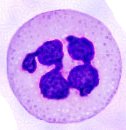
Granulocytes are granulated leukocytes generated by granulopoiesis in the bone marrow. Because their nuclei vary in shape (usually 3-lobed) granulocytes are also termed polymorphonuclear leukocytes (PMN, PML). Usually, the term polymorphonuclear leukocyte is used to designate neutrophil granulocytes, which are the most abundant of the granulocytes.
The granules are named according to their staining characteristics with hematoxylin and eosin (H&E) :
● Basophil granules stain purple
● Eosinophil granules stain red
● Neutrophil granules stain a neutral pink
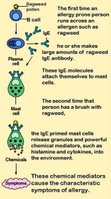 Mast cells contain metachromatic granules that store inflammatory mediators, including rich in histamine and heparin. Mast cells react to allergens and other degranulating agents with sequential exocytosis (description). Mast cells function in wound healing, in autoimmune disorders, and in the inflammatory and immune responses, including allergic reactions and anaphylaxis. (image at left - click to enlarge).
Mast cells are morphologically similar to basophils and both express CD34, though they may have different bone marrow precursors. Unlike basophils, masts cell circulate in an immature form, maturing only in tissue sites where they are resident. Mast cells are found in connective tissue of most organs, and in mucosal tissue.
Mast cells can be activated when an allergen binds to the IgE that is already coating the cell. Allergens are typically proteins or polysaccharides that bind to the Fab segment of the cognate IgE coating the mast cell surface. Crosslinking of two or more IgE molecules is required to activate the mast cell when steric changes disturb the cell membrane structure, triggering an intracellular cascade that activates the mast cell. Although this reaction is most often encountered in allergic reactions, it apparently evolved as a defense system against intestinal parasitism, such as tapeworm infestations.
Mast cells express pattern-recognition receptors plus high-affinity receptor (FcεRI) for IgE, which ligates specific IgE molecules irreversibly.
On activation, mast cells degranulate, releasing preformed mediators into the interstitium:
● histamine
● proteoglycans, mainly heparin (anticoagulant)
● serine proteases
● freshly synthesized lipid mediators (eicosanoids) Eicosanoid Actions :
_ ● prostaglandin D2 (PGD2)
_ ● leukotriene C4 (LTC4)
● cytokines
Complement Receptors Cytokines Eicosanoid Actions Fc receptors Immune Cytokines Immunoglobulins Interferons Scavenger Receptors Toll-like Receptors
▲ Top ▲
tags [Immunology] [WBC] [granulocyte]

The granules are named according to their staining characteristics with hematoxylin and eosin (H&E) :
● Basophil granules stain purple
● Eosinophil granules stain red
● Neutrophil granules stain a neutral pink
 Mast cells contain metachromatic granules that store inflammatory mediators, including rich in histamine and heparin. Mast cells react to allergens and other degranulating agents with sequential exocytosis (description). Mast cells function in wound healing, in autoimmune disorders, and in the inflammatory and immune responses, including allergic reactions and anaphylaxis. (image at left - click to enlarge).
Mast cells are morphologically similar to basophils and both express CD34, though they may have different bone marrow precursors. Unlike basophils, masts cell circulate in an immature form, maturing only in tissue sites where they are resident. Mast cells are found in connective tissue of most organs, and in mucosal tissue.
Mast cells can be activated when an allergen binds to the IgE that is already coating the cell. Allergens are typically proteins or polysaccharides that bind to the Fab segment of the cognate IgE coating the mast cell surface. Crosslinking of two or more IgE molecules is required to activate the mast cell when steric changes disturb the cell membrane structure, triggering an intracellular cascade that activates the mast cell. Although this reaction is most often encountered in allergic reactions, it apparently evolved as a defense system against intestinal parasitism, such as tapeworm infestations.
Mast cells express pattern-recognition receptors plus high-affinity receptor (FcεRI) for IgE, which ligates specific IgE molecules irreversibly.
On activation, mast cells degranulate, releasing preformed mediators into the interstitium:
● histamine
● proteoglycans, mainly heparin (anticoagulant)
● serine proteases
● freshly synthesized lipid mediators (eicosanoids) Eicosanoid Actions :
_ ● prostaglandin D2 (PGD2)
_ ● leukotriene C4 (LTC4)
● cytokines
Complement Receptors Cytokines Eicosanoid Actions Fc receptors Immune Cytokines Immunoglobulins Interferons Scavenger Receptors Toll-like Receptors
▲ Top ▲
tags [Immunology] [WBC] [granulocyte]
Labels: basophils, eosinophils, granulocytes, granulopoiesis, leukocytes, neutrophils, PML, PMN, polymorphonuclear leukocytes
| 0 Guide-Glossary