Costimulation involves ligand-receptor interactions at the surfaces of a responder
lymphocyte and an "accessory" cell –
APCs for
activation of
T cells, and
helper T cells for
activation of
B cells.
▼
activation B :
activation T :
anergy :
CD28 receptor :
CD28RE :
CDC42 :
costimulatory molecules :
first/second signals :
helper T cell :
IL-2 :
MAPK cascade :
MHC class II :
negative regulators :
Rac :
regulatory mechanisms :
Rel-NFkB :
Rho GTPases :
TCR engagement :
TCR threshold reduction :
transcription factors :
WASP ▼
 Activation
of
B cells occurs
when a
BCR (
antibody) encounters and
ligates its
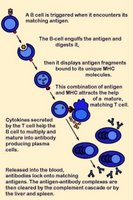
cognate antigen. Naïve B cells each have one of millions of distinct surface antigen-specific receptors, yet have not encountered their specific, cognate antigen. With a
life-span of only a few days, many B cells
die without ever encountering their cognate antigen. In most cases, B-cell activation is dependent upon costimulation by an activated
helper T cell that has itself been activated by the same antigen. (click images to enlarge)
Unlike T cells, B cells are coated in
immunoglobulin receptors and are able to recognize
intact antigen, which they engulf, digest, and subsequently
present in complex with surface
MHC class II molecules. The MHC-peptide complex binds
CD4 + helper T cells (
Th), inducing secretion of
cytokines that stimulate B cell
proliferation and their
differentiation into
plasma cells, which secrete specific
antibodies that bind with the cognate antigen. These antigen-antibody complexes are subsequently cleared by liver and spleen cells and the
classical complement cascade.
 Activation
of
T cells requires (1)
TCR engagement, which ensures
antigen specificity and
MHC restriction of the response. However,
synergistic signaling by (2)
costimulatory molecules is also necessary to sustain and integrate TCR signaling to stimulate optimal T cell
proliferation and
differentiation.
Delivery of
first signal (
TCR engagement) in the absence of
costimulation by a second signal(s) results in
apoptosis or
anergy. Anergic T cells neither produce
IL-2 nor
proliferate upon restimulation. This requirement of naïve T cell activation for delivery of both antigen-specific and costimulatory signals implies that only professional antigen presenting cells can initiate T cell responses.
Activation-
regulatory mechanisms:
● increasing TCR avidity (adhesion molecules)
● enhancing recruitment of tyrosine kinases to the TCR complex coreceptors (CD4 and CD8)
● costimulation involving reciprocal and sequential signals between cells
Negative regulators of costimulation include receptors that bind B7 family members:
●
CTLA-4● PD-1
Molecules involved in costimulation include:
1. Disulfide-linked homodimers that bind to distinct members of the B7 family of surface proteins
---●
CD28 ↓
---● ICOS (inducible costimulator) molecules
2. Members of the TNF receptor (TNFR) family
---●
CD40, the major B cell costimulatory molecule
---●
CD30---●
CD27---● OX-40
---● 4-1BB
The
CD28 receptor is involved in the best characterized costimulatory pathway. CD28 is the primary costimulatory molecule for naïve T cells, although
CD4+ helper T cells are more dependent than are
CD8+ killer T cells on CD28 costimulation. CD28 binds the CD80 (
B7-1) and CD86 (
B7-2) ligands that are expressed on antigen presenting cells (
APCs). CD28 costimulation increases T cell responses in naïve cells by increasing
cytokine (mainly
IL-2) production, which results from an increase in both cytokine
gene transcription and
mRNA stabilization.
CD28 signaling involves the activation of the small
Rho family
GTPases Rac and
CDC42, which activate p21-activated
kinase. This may link them to the
mitogen-activated protein kinase cascades and the subsequent induction of
IL-2 synthesis. Rac and CDC42 are also important in CD28-mediated cytoskeletal rearrangements, through the action of the Wiscott-Aldrich syndrome protein (
WASP).
CD28 costimulation increases the activity of nuclear
transcription factors of the
Rel/NFkB family, whose members bind the
CD28-responsive element (CD28RE) present in several cytokine gene promoters.
CD28 triggering reduces the number of engaged TCRs necessary to induce cytokine production and cell
proliferation. This
threshold reduction for T-cell activation is attributed to CD28-induced recruitment of
lipid rafts to the immunological synapse, which promotes recruitment of
raft-associated kinase and adapter molecules.
▲
activation B :
activation T :
anergy :
CD28 receptor :
CD28RE :
CDC42 :
costimulatory molecules :
first/second signals :
helper T cell :
IL-2 :
MHC class II :
negative regulators :
plasma cells :
Rac :
regulatory mechanisms :
Rel-NFkB :
Rho GTPases :
TCR engagement :
TCR threshold reduction :
WASP ▲
Tables
Fc receptors
Immune Cytokines
Immunoglobulins▲
Top ▲
tags
[Immunology][costimulation][activation]Labels: activation, B cells, BCR, co-stimulation, cognate antigen, first signal, immunoglobulin receptors, MHC, T cells, TCR
|