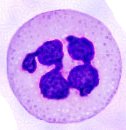
 Neutrophils, or polymorphoonuclear cells (PMNs), or heterophils are the commonest granulocytes and leukocytes, and are packed with granules that stain neutral (pink with H&E).
Neutrophils are phagocytic cells that normally circulate in the bloodstream. However, 'polys' quickly migrate into sites of infection or acute inflammation → after chemotaxis to reach the active sites, PMNs marginate along the vessel's endothelium, experience selectin-dependent capture and integrin-dependent adhesion, then extravasate into tissues, where they persist for 1-2 days. Neutrophils spend all their energy reserves in a self-and-pathogen-destructive respiratory burst, utilizing a NADPH oxidase complex that is assembled upon neutrophil activation.
Neutrophils contain specific, azurophilic, and tertiary granules:
● specific granules
_ ● α-defensins – small cysteine rich, cationic proteins found in both invertebrates and vertebrates
_ ● alkaline phosphatase
_ ● becteriocidal lactoferrin
_ ● NADPH oxidase
● azurophilic granules
_ ● lysozyme
_ ● bactericidal/permeability increasing protein (BPI)
_ ● myeloperoxidase
_ ● serine proteases – neutrophil elastase and cathepsin G
● tertiary granules
_ ● cathepsin proteases
_ ● gelatinase
● neutrophils can also extrude neutrophil extracellular traps (NETs), a web of chromatin and serine protease fibers that trap and kill microbes extracellularly and independent of phagocytic activity
● azurophilic granules are primarily lysozymes that are found in all three types of granulocyte
Tables Complement Receptors Cytokines Fc receptors Immune Cytokines Immunoglobulins Interferons Scavenger Receptors Toll-like Receptors
tags [Immunology] [leukocyte] [granulocyte] [neutrophil]
No comments:
Post a Comment
Note: Only a member of this blog may post a comment.